Field Notes / Stories
southern hercules
The Legend of Big Henry Shoaf
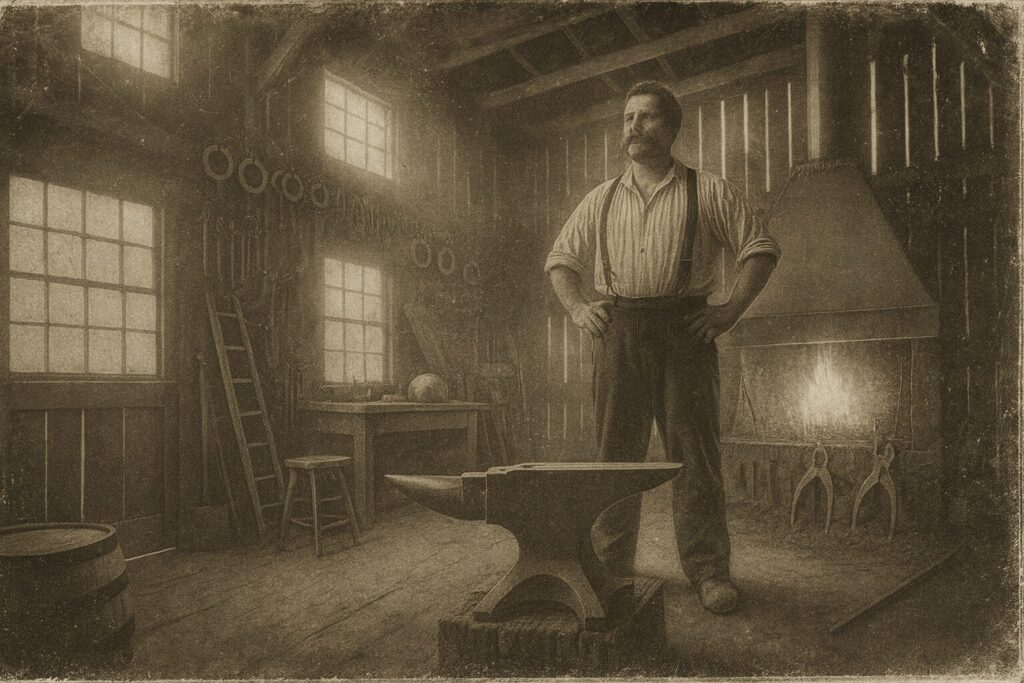
Let us tell you about a man—no, a mountain. A tall stretch of shadow cast across the red clay. A laugh that echoed through the tall, tall pines. Stories carried by creeks and rivers that never stopped flowing.
Big Henry Shoaf, they called him. A man as big as the stories told about him. A heart as wide as the Yadkin, a laugh that could shake the rafters, and a legend that only grew taller with time.
A Name That Rolled Like Thunder.
Back in the 1800s, Big Henry Shoaf’s name carried weight—both the kind you measure in pounds and the kind that settles into stories told on front porches long after sundown. Folks from Davidson County to the next ridge over knew of him, and maybe even a few beyond that. He was a blacksmith, broad and burly, standing seven feet tall and weighing 400 pounds. You could say he was built like an ox, but an ox don’t shake the earth when it walks.
The Shoaf name had been in North Carolina long before Henry came along. His great-granddaddy, Johann Heinrich “John Henry” Shoaf, stepped off a boat from the German territories of the Holy Roman Empire in 1739, settled in Pennsylvania for a spell, then made his way down to North Carolina in 1755. He put down roots deep enough that when Big Henry was born in 1814, he came into a land already steeped in family history, where the Shoaf name was etched into barn beams and gravestones alike.
Henry was one of twelve young’uns, and if family lore holds true, he went on to have near about as many of his own—some say eleven, some say more. He lived his whole life in and around Tyro, a patch of North Carolina where the red clay dust rises in the summer and the winters settle in soft and quiet. He grew up in a time when the land shaped the man as much as the man shaped the land. When blacksmiths were the backbone of a town. When legends weren’t just born, they were forged from grit, story, and the voices that kept them alive.
The Stone That Wouldn’t Move.
Here’s how the story goes: Big Henry was building a barn, its walls of ax-hewn logs reaching toward the sky. He needed a cornerstone—a boulder heavy enough to anchor it for generations. His neighbors came to help, rolling the stone onto a wagon with poles, their sweat soaking into the red dust. But the wagon gave way beneath the weight, leaving the stone right where it started.
But Henry, oh, he watched like a man who already knew how the story would end. He stepped forward, arms like iron, legs like tree trunks, lifted the boulder off the ground and carried it for twelve long strides—twelve paces of history—and dropped it into place.
The stone’s still there, they say. Covered in moss now, chipped away by hands that wanted to steal a piece of something bigger than themselves. Maybe they thought if they took a fragment of the stone, they’d carry a little of his strength with them.
The Forge and the Heart.
A blacksmith by trade, Big Henry lived in the forge, hammer in hand, sweat dripping from his brow like the rain that shapes the hills. Farmers came from miles around, not just for his tools but for the spectacle of the man himself. They say he could lift an anvil by the horn, swing it like it was a saddle.
But there was more to Henry than brute strength. At the end of the day, when the hammer was quiet and the fire had dimmed, he’d step into the music. He’d dust off the soot, and his feet would hit the floorboards, and the world would sway in time. He danced like gravity wasn’t a law, like the earth spun just for him.
Henry’s heart wasn’t a small thing either—it stretched across a dusty Carolina road, two sisters holding each side. Catherine and Elizabeth Koontz. One was his wife, the other his common-law partner, and together they shared a life as unconventional as the man himself.
Their homes stood on opposite sides of the same road, connected by the steady footsteps of a man who managed to bridge two worlds without letting either fall apart. Between the two sisters, Henry fathered more than 20 children, a sprawling legacy that stretched as wide as his shadow.
The Ghost in the Coffin.
They say Big Henry, half-drunk on moonshine and full of mischief, started wrestling with a coffin one night, its heavy wood creaking under his grip. At first, it was a lark, a laugh, the kind of thing you’d tell on a porch years later. But that night had other plans.
As the story goes, the coffin began to twist and writhe, its solid wood turning spectral, shimmering like smoke caught in moonlight. Whatever it was—haint, spirit, or some trick of the dark—it came alive, cold and relentless, chasing Big Henry across the fields.
They say he ran hard for his forge, the only place he trusted to keep the spirit at bay. The iron, the fire—they were his weapons, and they stood between him and whatever had crawled out of that coffin.
What Happens to Stories When They’re No Longer Told?
When Henry Shoaf passed in 1884, his grave was marked only by a humble pile of stones. Decades later, a proper headstone was raised to honor him. But the true weight of Big Henry’s life lies in the stories that remain—the ones told and retold around dinner tables, on front porches, and in the minds of those who still marvel at the man who seemed more mountain than mortal.
Big Henry Shoaf was more than a man, more than a legend—he is a story. The kind people used to carry around in their pocket, worn smooth from retelling, like a lucky coin. You don’t have to search long in any family tree to find a Big Henry—a name or a face wrapped in legends and tall tales.
But legends don’t live forever on their own. Without voices to speak them, hearts to believe in them, and wonder to keep them alive, they fade—slipping into the cracks of time like rain vanishing into the ground. And once they’re gone, they don’t come back.
That’s why we tell them.
Acknowledgement & Postscript
This work is inspired by a rich tapestry of family oral traditions and regional histories, woven together through the voices of those who carried these stories forward. The interpretations are our own, with deep gratitude to the storytellers and keepers of the past.
The tale of the boulder, passed down through generations, stands as a testament to both legend and fact. Accounts estimate its weight to be nearly 1,000 pounds—a figure confirmed decades later when the stone was measured on a truck scale, proving that some stories are as solid as the ground they rest on.
—Foulk Davis